

How to Qualify for Medicaid Home Care in NC
Get the Guidance You Deserve, Right to Your Inbox
Whether you’re a caregiver, care professional, or individual seeking independence, We aim to keep you informed and inspired. Receive updates on services, events, and stories of hope by signing up to become a part of our email list below.
To qualify for Medicaid home care in North Carolina, most adults must meet four requirements: North Carolina residency and U.S. citizenship or qualified non-citizen status, a documented need for help with daily activities, income within Medicaid limits, and countable assets within Medicaid limits. Adults whose income is above the limit may still qualify through a medically needy deductible.
This guide is for adults with intellectual and developmental disabilities (IDD), traumatic brain injury (TBI), or other disabilities, and for the family members and care partners who help them apply. Medicaid is the primary payer for long-term services and supports, including care at home, according to KFF.
What Is Medicaid Home Care?
Medicaid home care, also called home and community-based services (HCBS), pays for support delivered at home or in the community instead of in a facility. Services can include help with bathing, dressing, eating, and mobility, along with supports that build independence in daily life. Medicaid.gov explains how HCBS works nationally, and NC Medicaid lists the programs available in North Carolina.
Adults with IDD often reach home care through the NC Innovations Waiver, which serves individuals who need an intermediate care facility (ICF-IID) level of care. The waiver has a waitlist, so starting early helps. Other individuals may qualify for Medicaid personal care services or NC Medicaid 1915(i) services.
Four Requirements for Medicaid Home Care in NC
Most adults must meet all four requirements, and each one has its own paperwork. The table shows what to expect, and the sections below explain each one.
| Requirement | What it means | Have ready |
|---|---|---|
| Residency and citizenship | Live in North Carolina; be a U.S. citizen or qualified non-citizen | Photo ID, proof of NC address, proof of citizenship or status |
| Level of need | A documented need for help with daily activities, or a facility level of care | Diagnosis records, recent evaluations |
| Income | Countable monthly income within the limit for the program | Benefit letters, pay stubs |
| Assets | Countable resources within the limit, generally $2,000 for one person | Bank and account statements |
1. Residency and Citizenship
The applicant must live in North Carolina and be a U.S. citizen or a qualified non-citizen. This is usually the most direct requirement to document.
2. Medical Need
Medicaid requires proof that support is needed. That usually means help with activities of daily living (ADLs) such as bathing, dressing, eating, toileting, and mobility, or a level of care that would otherwise be provided in a facility. For adults with IDD, the NC Innovations Waiver requires an ICF-IID level of care determination. An assessment confirms the need, and a case manager can help gather the records it relies on.
3. Income Limits
Medicaid limits countable monthly income, and the limit changes each year and differs by program. Confirm the current limit with your county Department of Social Services (DSS) before you apply. Two points help many families. For the NC Innovations Waiver, NC DHHS policy counts only the applicant’s own income, not a parent’s or spouse’s. And adults ages 19 to 64 with income up to 138% of the federal poverty level may qualify under NC Medicaid expansion, which began December 1, 2023.
4. Asset Limits
For most aged, blind, and disabled Medicaid coverage, North Carolina limits countable resources to $2,000 for an individual and $3,000 for a couple. Not every asset counts: a primary home, one vehicle, and personal belongings are typically excluded. Confirm current limits with your county DSS.
What If Income or Assets Are Over the Limit?
Being over a limit does not always rule out Medicaid. Many adults still qualify through one of these routes:
- Medically needy deductible (spend down). Medicaid subtracts medical expenses from income until the remainder falls within the limit. In North Carolina, applicants above the income limit may qualify after they meet a deductible.
- Special needs trusts and ABLE accounts. When set up correctly, these tools can set aside funds for an adult with a disability without counting as an available asset. An elder law or special needs attorney can advise on the right structure.
- Case management guidance. A case manager can explain which program fits and what to document, so families do not have to guess.
This guide is general information, not legal or financial advice.
How to Get Started
Starting with the right program saves time. These four steps work for most adults and the people supporting them:
- Confirm which program fits. Read how to apply for Medicaid and the NC Innovations Waiver guide.
- Gather documents. Collect the items listed below.
- Apply for NC Medicaid. Apply through NC Medicaid or your county DSS.
- Connect with a case manager. Learn how to find a Medicaid caseworker or how to get a case manager with Medicaid, and see how CCMS provides IDD and TBI case management.
Documents to gather
- Photo ID and proof of North Carolina residency
- Proof of U.S. citizenship or qualified non-citizen status
- Benefit award letters, pay stubs, and other proof of income
- Bank and account statements
- Diagnosis records and recent evaluations
- Current Medicaid, Medicare, and insurance cards
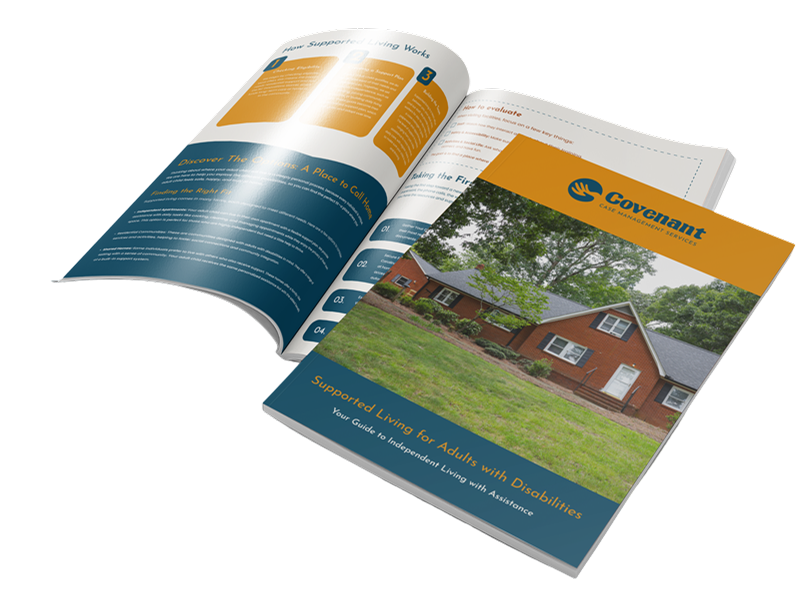
To see what daily support at home can look like, explore CCMS services or download the free Supported Living Guide.
Frequently Asked Questions
Does Medicaid pay for home care in North Carolina?
Yes, for individuals who qualify. NC Medicaid covers home and community-based services that help adults live at home, including personal care and, for adults with intellectual and developmental disabilities, services through the NC Innovations Waiver. Eligibility depends on residency, level of need, income, and assets.
What is the asset limit for Medicaid in North Carolina?
For most aged, blind, and disabled Medicaid coverage, countable resources are limited to $2,000 for an individual and $3,000 for a couple. A primary home, one vehicle, and personal belongings are typically not counted. Confirm current limits with your county Department of Social Services.
Does a parent’s income count when an adult with a disability applies for the NC Innovations Waiver?
No. NC Medicaid policy for the Innovations Waiver counts only the applicant’s own income, with no parent-for-child or spouse-for-spouse financial responsibility. Other Medicaid programs follow different rules, so ask your caseworker which program applies.
What is the Medicaid income limit for home care in North Carolina?
Income limits change every year and differ by program, so no single number applies to everyone. Confirm the current limit for your program with your county Department of Social Services. If income is above the limit, a medically needy deductible, often called a spend down, may still allow an adult to qualify.
How is Medicaid home care different from Medicare home health?
Medicare covers home health services only for people who are homebound, and it does not cover personal care services. Medicaid is the primary payer for long-term services and supports, including care at home.
Who can help me apply for Medicaid home care in North Carolina?
A case manager can explain which program fits, help gather documents, and coordinate assessments. Covenant Case Management Services (CCMS) provides CARF-accredited case management for individuals with intellectual and developmental disabilities (IDD) and traumatic brain injury (TBI) across North Carolina.
About Covenant Case Management Services
Covenant Case Management Services (CCMS) provides CARF-accredited case management for individuals with intellectual and developmental disabilities (IDD) and traumatic brain injury (TBI) across 56+ North Carolina counties. Since 2010, CCMS has served 800+ individuals, supported by 300+ direct support professionals. Our team is based in Albemarle, NC.
Ready to talk through your options? Contact CCMS or call (704) 780-4552.


Download Your FREE Supported Living Guide!

Direct Support
Professionals

Individuals Served
Since 2010
