
Free Family Roadmap
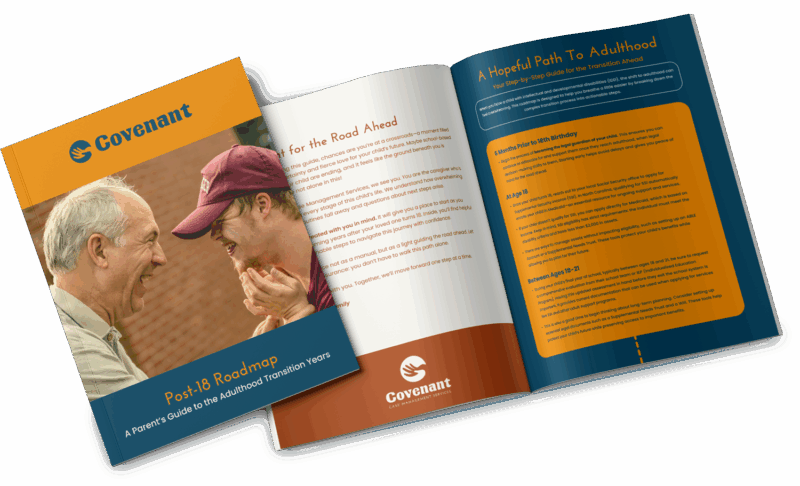
Post-18 Roadmap: A Guide to the
Adulthood Transition Years
The year around your child's 18th birthday brings real decisions about benefits, legal rights, and services. This roadmap lays out exactly what changes, when to act, and how to keep support in place with no gaps.
Free Download
Get the Full Roadmap, Free
Everything below, plus a printable month-by-month planner you can keep on the fridge, in one guide built specifically for North Carolina families.
- What to do before your child turns 18 so you can keep advocating for their needs without a gap.
- How to apply for SSI and Medicaid as an adult, plus tips to protect eligibility along the way.
- A side-by-side look at guardianship, supported decision-making, and power of attorney.
- How the NC Innovations Waiver, supported living, and day programs fit into adult life.
- A printable planner to track applications, appointments, and important contacts.
Start Here
What Changes at Age 18?
In North Carolina, 18 is the legal age of majority. For a young adult with intellectual or developmental disabilities (IDD), that single birthday can shift benefits, legal rights, and services all at once, so it helps to know what is coming before it arrives.
Three things change at the same time. First, income-based benefits like SSI and Medicaid start looking at your child's own income and assets instead of your household's, which actually makes many young adults newly eligible. Second, your child gains full legal authority over their own decisions unless a court or a signed agreement says otherwise. Third, school-based transition services eventually taper off, and adult services like the NC Innovations Waiver, vocational rehabilitation, and day programs take their place. None of this has to happen all at once, and none of it has to catch you off guard.
Age of majority. The age at which a person is legally recognized as an adult. In North Carolina, that age is 18. It is the trigger point for the benefits, legal, and service changes covered in this guide.
What You'll Learn
What's Inside the Free Roadmap
The full guide walks your family through each of these in plain language, with a printable planner to keep you on track. Here's a preview of what's inside.
Legal Decision-Making Options
Guardianship, supported decision-making, and power of attorney compared side by side, so you can see which fits your family.
See the comparison →Benefits & Income
How adult SSI and Medicaid eligibility work, and what an ABLE account can do to protect savings.
Check eligibility →NC Innovations Waiver & Day Services
How your child's person-centered plan shifts to adult supports like supported living and day programs.
Explore day services →Month-by-Month Planner
A printable timeline for the 12 months before and after your child's 18th birthday, so you always know the next step.
See the timeline →Benefits & Income
How Benefits Change After 18
Quick answerAt 18, Supplemental Security Income (SSI) and Medicaid eligibility switch from being based on your household income to being based on your child's own income and resources, which is why many young adults with IDD become newly eligible around this age.
Applying for Adult SSI and Medicaid
The Social Security Administration re-evaluates disability claims using adult rules once your child turns 18, and parental income no longer counts against eligibility. It is worth applying even if your household income disqualified your child before. On the Medicaid side, your child's NC Medicaid eligibility is also recalculated using their own income, and if they are already enrolled in the NC Innovations Waiver, their case manager updates the person-centered plan to reflect adult goals and supports.
Protecting Savings with an ABLE Account
SSI and Medicaid both cap how much a recipient can have in savings before losing benefits. An ABLE account is a tax-advantaged savings account built specifically for people with disabilities that lets your child save above those limits for things like housing, education, transportation, and daily living costs, without putting benefits at risk.
Legal Decision-Making
Guardianship vs. Supported Decision-Making vs. POA
Turning 18 does not automatically mean your child needs a guardian. North Carolina recognizes several ways to support decision-making, each with a different level of court involvement and a different effect on your child's legal rights. This is general information, not legal advice. Talk with an attorney or your case manager before choosing a path.
| Feature | Full Guardianship | Supported Decision-Making | Power of Attorney |
|---|---|---|---|
| What it is | A court appoints a guardian to make decisions for the person | A legal agreement where the person keeps their rights and chooses trusted supporters | The person authorizes an agent to act on specific matters they choose |
| Who decides | The guardian decides, the person's legal rights are limited | The person decides, with guidance from chosen supporters | The person decides, the agent acts within the scope granted |
| Court involvement | Requires a court petition and hearing | No court process, a written agreement | No court process, a signed legal document |
| Best fit for | Someone who cannot make or communicate safe decisions even with support | Someone who can decide with guidance and wants to keep their legal rights | Someone who wants help with specific decisions while keeping full authority |
North Carolina's guardianship process runs through the NC courts, and supported decision-making is recognized under state law as a less restrictive alternative. Disability Rights NC has more detail on how supported decision-making agreements work in practice.
Getting Started
How to Move Forward
These are the three stages most families move through around their child's 18th birthday, and CCMS can help at any point.
Start the Conversation Early
Begin 6 to 12 months before your child turns 18. If they have an IEP, NC schools are required to address transition planning starting at age 14, so use those meetings to start mapping out adult goals.
Reapply for Benefits as an Adult
File for adult SSI using disability rules that no longer count your household income, confirm your child's Medicaid eligibility under the new rules, and check in with their case manager if they are already on the NC Innovations Waiver.
Choose the Right Support Path
Decide among guardianship, supported decision-making, or power of attorney with the help of an attorney, and consider a representative payee or an ABLE account to help manage day-to-day finances.
Your Advocate
Why Families Partner with Covenant
The transition to adulthood works best when someone who knows the NC system is walking through it with you. Here's what that looks like with our team.
- Person-centered planning. Every plan starts with your loved one's own goals, not a generic template.
- Statewide, CARF-accredited care. We serve families across 56 North Carolina counties as a CARF-accredited provider.
- One point of contact. A dedicated care coordinator helps you navigate benefits, providers, and paperwork.
- Support that grows with independence. Ongoing monitoring means the level of help adjusts as your loved one's needs change.
Common Questions
Frequently Asked Questions
What changes when my child with IDD turns 18 in North Carolina?
At 18, your child becomes a legal adult under NC law. Benefits like SSI and Medicaid start being based on their own income and assets instead of yours, they gain the legal right to make their own decisions unless a court says otherwise, and school-based transition services eventually give way to adult services like the NC Innovations Waiver and vocational rehabilitation.
Does my child need a guardian once they turn 18?
Not automatically, and not always. Guardianship is one option among several, including supported decision-making and power of attorney. Many young adults with IDD can keep their legal rights and get help through a supported decision-making agreement. A guardianship is appropriate only when someone cannot make or communicate safe decisions even with support, and it requires a court petition and hearing. This is general information, not legal advice, so talk with an attorney or your case manager about which option fits your family.
How does turning 18 affect Medicaid and the NC Innovations Waiver?
Once your child turns 18, Medicaid eligibility is recalculated using their own income and resources instead of household income, which often makes more young adults with IDD newly eligible. If they are already on the NC Innovations Waiver, their case manager reviews the person-centered plan as they enter adulthood, adjusting supports like supported living or day programs to match their next stage of life.
When should we start transition planning?
Start at least 6 to 12 months before your child's 18th birthday, and ideally earlier through the IEP transition planning process, which NC schools are required to address starting at age 14. Early planning gives you time to apply for adult benefits, decide on a legal decision-making option, and line up services with no gap in support.
What is an ABLE account and do we need one?
An ABLE account is a tax-advantaged savings account for people with disabilities that lets them save above the usual SSI and Medicaid asset limits without losing benefits. It is optional, but many families set one up around age 18 to build savings for housing, education, or daily living costs without jeopardizing eligibility.
Go Deeper
More Resources
Official Resources
Primary sources for the benefits and legal details above.
Related from Covenant

Our Promise
Adulthood Is a Beginning, Not a Cliff
The transition to adult services should feel like a handoff, not a drop-off. As your loved one steps into this next stage, we make sure their support moves with them, not around them.
Ready to Talk?
Let's Plan the Transition Together
Whether your child's 18th birthday is next month or next year, our care coordinators can help you map out benefits, legal options, and services, county by county, step by step.